
Permission to Let Go
Welcome to The Lovely Day Letters—a collection of reflections on healing, bodywork, and the people behind Lovely Day.
This letter was originally shared with our email subscribers. I’m so glad you’re here.
I've been thinking a lot about unwinding lately.
It's something I'm still learning about. Something I'm actively practicing in my own self-treatment, something I've experienced at seminars and on treatment tables, and something I've had the privilege of witnessing in my own treatment room.
Today, I supported a client through a pretty big unwinding. And now, at the end of the day, I'm sitting here with a glass of water, resting and reflecting on some of the themes that session brought up for me.
And I thought...I want to write about this.
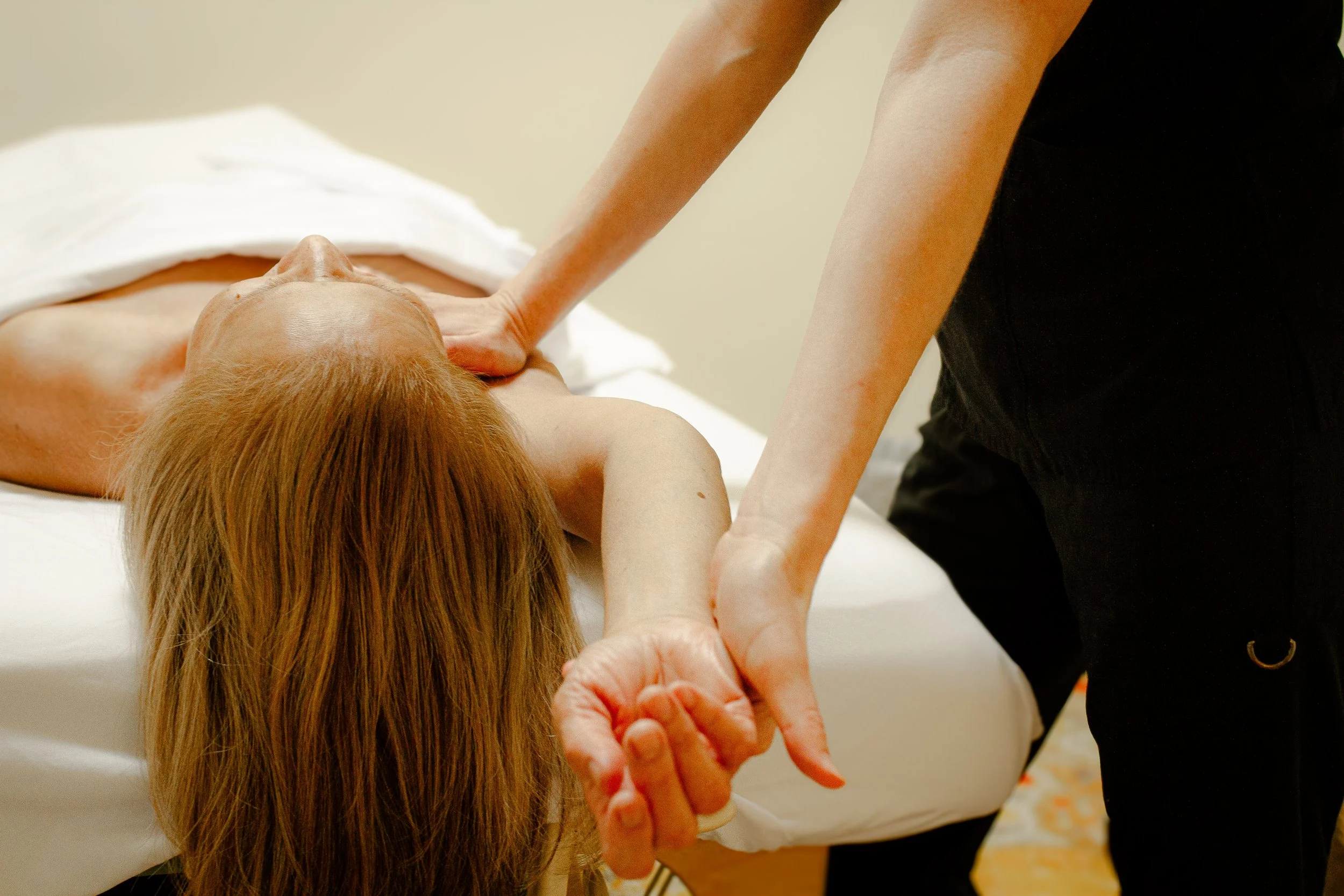
If you're unfamiliar with unwinding, it can look a little unusual from the outside. In myofascial release, we sometimes allow the body to move intuitively rather than directing it into a particular position. There can be stretching, twisting, sounds, emotion, stillness. Sometimes a lot happens. Sometimes almost nothing appears to be happening at all.
The idea is surprisingly simple:
Instead of telling the body where to go, we get curious about where it wants to go.
Today, my job was mostly to follow.
There wasn't much talking.
She moved, and I supported her. When she needed somewhere to lean, I was there. When movement gave way to stillness, I waited. When it felt right to return to more structural work, I followed what my hands were finding.
It feels like a dance. Not one either of us know the steps to.
There is a quiet, nonverbal conversation happening between us the whole time:
I'm here.
I've got you.
I'll follow wherever you need to go.
The presence we were both experiencing had an energy of its own that felt palpable to me. And she allowed herself to follow it.
It's incredible to witness a person step fully into themselves and really express what's there so authentically.
After the treatment was over, I noticed a subtle shift in her demeanor. I don't have the perfect word for it. Maybe it was renewed confidence or self-possession.
There was an ease about her, but also this quiet kind of strength. Like she had settled more fully back into herself.
And it was beautiful.
On the other side of the wall, a completely different treatment was happening.
Without sharing the details of someone else's session, I'll just say that hearing about it afterward brought up another side of all of this for me.
Letting go isn't always easy.
We spend our entire lives learning how we're supposed to exist around other people. How to sit. How much space to take up. Who we're allowed to touch and how. What sounds and emotions are appropriate. How to be polite. How to be professional. How to hold it together.
And there's nothing inherently wrong with any of that. We need social awareness. We need boundaries. We need ways of living together.
But how often do we stop to think about how much of that instruction has made its way into our bodies?
Because suddenly something as simple as let your arm be heavy isn't necessarily simple.
Let me support you.
Don't help me move you.
Rest.
Receive.
Let go.
Those things sound easy.
But are they?
How often are we deciding what our body should be doing instead of noticing what it's actually doing—or what it wants to do?
How often do we stop ourselves from moving, feeling, expressing, or connecting because some part of us has learned to be careful? To think before we act. To make sure what we're doing is okay.
And how much does all of that affect the way we interact not only with other people, but with everything in our lives—including our ability to rest, relax, receive, and enjoy?
Maybe that's part of what fascinates me so much about unwinding.
At its heart, I think unwinding can help us connect with something incredibly human.
What's real. What's underneath.
Before we decide what it should look like. Before we judge it or try to make it make sense.
Just...what is.
At times, for me, that can even feel spiritual. Not because I need to understand exactly what's happening, but maybe because I don't.
What matters to me is being able to create a space where someone can safely get curious about all of it. To notice what comes up and, when they're ready, see what happens when they allow themselves to be supported.
Because receiving is vulnerable too.
Letting someone else hold the weight of your arm—shoot, even resting can be vulnerable when you've spent a lifetime learning to hold yourself together.
And I think that's what today's sessions are really teaching me.
Maybe unwinding is more than releasing restrictions, traumas, or memories through movement or sound—or even what's happening underneath the skin with the structural releases.
Maybe sometimes unwinding is simply undoing some of the protection. Some of the control we think we need that may actually be holding us back from healing, fully living, or receiving all that life has to give us.
It takes practice to even notice this kind of conditioning in ourselves, much less begin to undo it.
But how much freedom there can be in giving ourselves permission, even for a little while, to let some of it go?
Until next time,
Wishing you a Lovely Day,
Paula
Join The Lovely Day Letters
If this reflection resonated with you, I'd love to have you join The Lovely Day Letters.
New letters arrive in subscribers' inboxes first, before they're shared here on the blog.
They're thoughts on healing, bodywork, and the people behind Lovely Day—along with things I'm learning, questions I'm sitting with, and whatever else seems worth writing about that week.
Sign up to receive The Lovely Day Letters →
Link that final line to: