

How fascial tension patterns may affect movement efficiency
You stretch. You strengthen. You practice.
And yet, there's that one movement that never seems to get easier.
Maybe one hip opens beautifully while the other feels stuck. Maybe your shoulder has plenty of range of motion, but reaching overhead still feels awkward. Or maybe you can perform a movement perfectly well—it's just taking more effort than you think it should.
It's tempting to assume you need to stretch more, strengthen something, or practice harder.
But what if there's another piece worth exploring?
Movement is a whole-body conversation
Think about an aerialist extending into a beautiful shape, a yogi moving into a deep twist, or a dancer balancing on one leg.
These movements don't happen at just one joint. They depend on coordinated contributions from muscles, joints, connective tissues, and the nervous system.
Your body is constantly distributing forces, adjusting tension, and finding ways to accomplish what you're asking it to do.
Sometimes those strategies are wonderfully efficient. Other times, a movement may require more effort or compensation than necessary.
Where fascia comes into the picture
Fascia is a continuous network of connective tissue that surrounds, separates, supports, and connects structures throughout the body.
It helps transmit and distribute mechanical forces, and its sensory properties contribute to how we experience and coordinate movement.
When tissues become less adaptable or movement patterns become habitual, the body may begin relying on different strategies to accomplish the same task.
For example, a restriction around the rib cage may influence how someone reaches overhead. Limited hip motion may change how the pelvis and spine contribute to a movement.
Fascial tension can influence more than how flexible you feel. It may affect how forces move through your body, how comfortably a joint moves, and how different muscles coordinate during a movement.
Sometimes what feels like a strength problem may involve a restriction elsewhere in the system.
I experienced this myself. My grip had become noticeably weak, and my wrist wasn't functioning the way it normally did. I was convinced something was wrong with my wrist. Every time I received treatment, I wanted the therapist to focus right there.
Eventually, I let go of directing the session and allowed the therapist to explore the larger pattern through my arm and shoulder. When they worked on an area of restriction in my upper trapezius, something remarkable happened: my wrist and grip function improved dramatically.
I had been so focused on where I felt the problem that I hadn't considered what might be happening farther up the chain.
That experience changed how I thought about movement restrictions.
This is why looking only at the area that feels tight—or the muscle that seems weak—may not reveal the bigger picture.
Previous injuries and surgeries offer another example. Scar tissue is part of the body's healing process, but changes in the connective tissue can sometimes affect how surrounding tissues glide and respond to movement. Myofascial release can be a useful hands-on approach for exploring scar-related restrictions and improving comfort and mobility.
What about fascial lines?
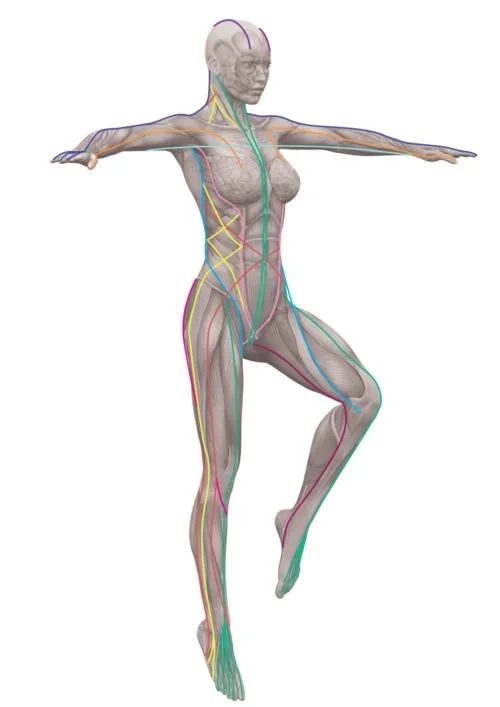
Illustration adapted from Tom Myers Yoga Journal: Anatomy 101 for Teachers and Students. Depicting fascial pathways that connect the neck, torso, pelvis, and lower limbs, highlighting how tension may relate across different regions of the body.
You may have heard of fascial lines—interconnected pathways of muscles and connective tissues described in models such as Tom Myers' Anatomy Trains.
These models offer a useful way to explore how tension and movement in one region may relate to another.
Imagine an aerialist who consistently struggles to extend through one side of the body.
Rather than assuming the problem is simply a tight shoulder or hip, we might explore how the ribs, spine, pelvis, and surrounding tissues participate in that movement.
Fascial lines are a clinical model for exploring these relationships.
Movement efficiency isn't about perfect posture
When I talk about movement efficiency, I don't mean that everyone should move in one ideal way.
Human bodies are wonderfully adaptable. We all have different structures, histories, and movement preferences.
I'm more interested in questions like:
Does this movement require more effort than it used to?
Does one side consistently feel different from the other?
Are you repeatedly stretching the same area without lasting change?
Do you find yourself holding your breath or bracing to accomplish a movement?
These observations give us useful clues while we explore and discover what might be holding your body back from full expression in movement.
If you're dealing with recurring tightness, discomfort, or movement restrictions that don't seem to respond to your usual routine, we'd love to help you explore the bigger picture.
Learn more or book a session: lovelydaymfr.com/booking